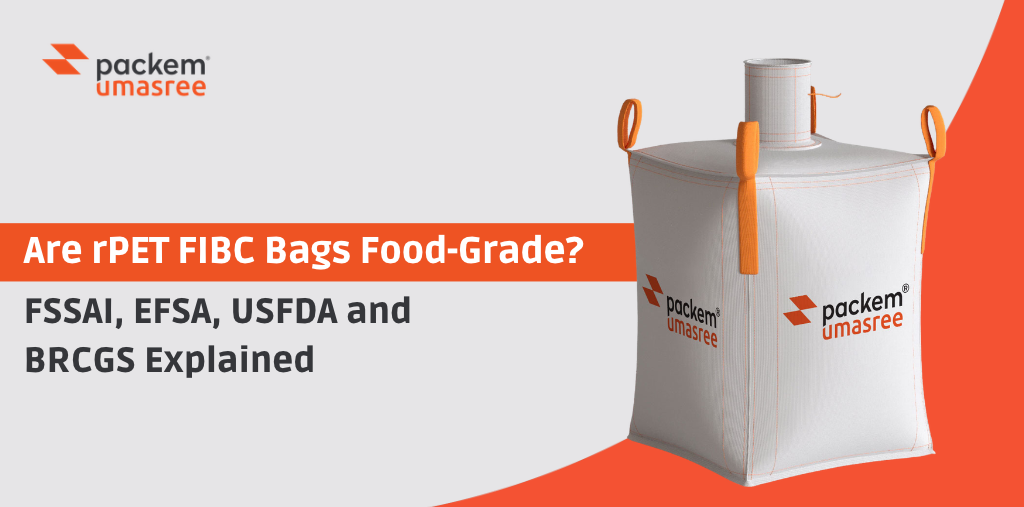
Food and ingredient manufacturers are increasingly looking for bulk packaging that combines strength, hygiene, regulatory compliance, and sustainability. This has created growing interest in rPET FIBC Bags, particularly for products such as sugar, nuts, seeds, rice, grains, food additives, and other dry ingredients.But one question needs a careful answer: Are recycled PET bulk bags actually food-grade?The answer is yes, recycled PET can be used for food-contact applications when the recycled material, recycling process, packaging manufacture, and intended use meet the applicable requirements. However, not every recycled PET material or every bulk bag automatically qualifies as food-grade.For businesses sourcing sustainable FIBC packaging, understanding the requirements of FSSAI, EFSA, USFDA, and BRCGS is therefore essential.
What Makes Recycled PET Suitable for Food Contact?
Recycled PET, commonly called rPET, is produced by processing used PET materials into a recycled raw material that can be used to manufacture new packaging products. In the case of post-consumer PET, the main concern is not simply whether the polymer is PET. The critical question is whether the recycling process can adequately control and remove potential contaminants.The USFDA highlights contamination and migration as important considerations when recycled plastics are intended for food-contact applications. It evaluates the recycling process, source controls, decontamination performance, and intended conditions of use.This distinction matters for FIBCs. A bag made with recycled PET intended for food ingredients needs more than a sustainability claim. Buyers should consider:
The source of recycled PET
The recycling and decontamination technology
Food-contact suitability of the recycled material
Migration and contamination controls
Manufacturing hygiene
Traceability
Applicable regulatory requirements
The specific food and conditions of use
In other words, food-grade status is a controlled manufacturing and compliance outcome, not simply a description of the material.
What Does FSSAI Say About Recycled PET?
For companies supplying or using packaging in India, FSSAI requirements are particularly important.The Food Safety and Standards Authority of India (FSSAI) has established provisions for recycled plastics used as food-contact materials. FSSAI’s packaging framework includes specific requirements for recycled PET and maintains a list of approved manufacturers of food-grade rPET resin for food-contact applications.FSSAI also made provisions for the use of recycled plastics in food packaging and operationalised guidelines concerning post-consumer PET recycling for food-contact applications.For packaging manufacturers and food businesses, this means the relevant question is not simply whether a product contains recycled PET. The recycled material and its production process must satisfy the applicable food-contact requirements.This is especially relevant when selecting bulk packaging for products that come into direct contact with the inside surface of the FIBC or its liner.
How Does EFSA Evaluate Recycled PET?
The European Food Safety Authority (EFSA) takes a process-focused approach to recycled plastic intended for food contact.EFSA explains that recycled plastic can present risks because contaminants from previous use or other waste streams may remain in the material. Its assessments therefore examine the recycling process and its ability to achieve adequate decontamination.EFSA has evaluated multiple recycling processes for post-consumer PET. In several assessments, the authority considered factors such as temperature, pressure, residence time, and other process parameters that influence decontamination efficiency. Where the evaluated process demonstrated adequate control, EFSA concluded that the resulting recycled PET could be used for specified food-contact applications.This is an important point for exporters.EFSA does not simply declare all rPET food-grade. The safety assessment relates to specific recycling processes and conditions of use.Therefore, buyers in Europe should ask suppliers for appropriate documentation showing that the recycled PET used in the packaging comes from a suitable, assessed process.
What Does USFDA Require for Recycled PET?
The United States Food and Drug Administration (USFDA) also focuses strongly on the recycling process.According to FDA guidance, manufacturers evaluating recycled plastic for food packaging should consider the source of the recycled material, controls preventing contamination, the effectiveness of the recycling process, and the intended conditions of use.For recycled PET, this can involve demonstrating that the recycling process produces material of suitable purity for the intended food-contact application.The FDA also considers factors such as:
Type of food contacted
Temperature of use
Duration of contact
Single-use or repeated-use conditions
Potential migration of contaminants
Controls over the recycled feedstock
This makes regulatory documentation an important part of supplier qualification for food businesses exporting to the United States.
Where Does BRCGS Fit In?
BRCGS is often mentioned alongside food-grade packaging, but it is important to understand what it actually does.The BRCGS Global Standard Packaging Materials provides a framework for packaging manufacturers to demonstrate product safety, quality, legal compliance, authenticity, and appropriate operational controls. Issue 7 is the current version of the Packaging Materials standard.BRCGS is therefore not the same thing as an EFSA or USFDA approval of a recycled PET recycling process.Instead, BRCGS certification addresses the management and manufacturing environment surrounding packaging production.Depending on the applicable requirements and scope, this can include areas such as:
Product safety management
Hazard analysis and risk assessment
Hygiene controls
Traceability
Manufacturing processes
Quality management
Contamination prevention
Legal compliance
Product specifications
BRCGS updated its Packaging Materials standard to Issue 7 in 2024, with changes including stronger emphasis on product safety culture, hazard analysis, risk assessment, continual improvement, and alignment with GFSI requirements.As a result, BRCGS certification can provide an additional layer of confidence when qualifying a packaging supplier, but it should be considered alongside the relevant food-contact material documentation.
Are rPET FIBC Bags Safe for Food Ingredients?
They can be, provided the complete packaging solution is designed and manufactured for the intended food-contact application.This is where buyers need to look beyond the word “rPET.”A food-contact bulk bag may involve several components, including the main fabric, liner, sewing thread, coatings, printing inks, closures, and other components. Each element can matter depending on how the packaging is constructed and used.For example, a dry food ingredient may require a suitable food-contact liner even when the outer FIBC fabric is manufactured from recycled PET.The intended application should therefore be clearly defined before selecting the packaging specification.For companies handling sugar, flour, grains, rice, food powders, or other dry ingredients, the supplier should be able to explain which components are intended for food contact and provide the relevant compliance documentation.
How Packem Umasree Approaches Food-Grade Bulk Packaging
Packem Umasree manufactures FIBCs using post-consumer recycled PET and follows a bottle-to-bag model in which PET bottles are processed into recycled PET material and converted into high-performance FIBC fabric. The company identifies food-grade applications among its sustainable bulk packaging solutions and highlights EFSA- and USFDA-approved Starlinger recycling technology together with BRCGS-certified manufacturing practices.Its product range includes U Panel, Circular, Baffle, and Single Loop FIBCs, allowing packaging specifications to be matched to different bulk-handling requirements.For example, the company’s U Panel and Single Loop product pages identify food-grade rPET as an available packaging material and highlight features such as high fabric strength, abrasion resistance, UV resistance, and recyclability.This approach combines recycled material sourcing with controlled manufacturing and application-specific packaging design.
What Should Buyers Check Before Ordering Food-Grade FIBCs?
Before purchasing sustainable bulk bags for food ingredients, procurement teams should ask suppliers for clear documentation rather than relying only on marketing terminology.A practical checklist includes:
Recycled material documentationConfirm the source and specification of the recycled PET.
Recycling-process evidenceAsk which recycling technology and process are used and whether the process has been assessed for food-contact applications.
Food-contact declarationRequest documentation covering the intended application and relevant regulatory requirements.
BRCGS certificationCheck whether the manufacturing facility holds the relevant BRCGS Packaging Materials certification and confirm its scope.
Product specificationReview the FIBC construction, liner, seams, closures, coatings, printing, and other components.
Intended conditions of useSpecify the food product, temperature, storage duration, handling conditions, and whether direct or indirect contact occurs.
Traceability and quality controlsConfirm that the supplier can trace materials and production batches when required.
This process helps food manufacturers avoid a common mistake: treating “recycled” and “food-grade” as interchangeable terms.
rPET vs Virgin PET for Food Packaging
Virgin PET has traditionally been associated with food-contact packaging because it starts with controlled raw material. Recycled PET adds another step: the recycling process must control potential contaminants from previous use.However, that does not mean recycled PET is inherently unsuitable for food applications.Modern recycling technologies can produce high-purity recycled PET when they are properly controlled and assessed. EFSA and USFDA evaluations demonstrate that specific recycling processes can be suitable for producing recycled PET intended for food-contact applications.For companies with sustainability targets, this creates an opportunity to reduce dependence on virgin materials while maintaining the required packaging performance and food-safety controls.
The Bottom Line: Is Recycled PET Bulk Packaging Food-Grade?
Yes, recycled PET can be used for food-contact packaging, but the answer depends on the complete compliance chain.FSSAI provides India’s regulatory framework for food packaging and recycled PET. EFSA evaluates the safety of specific recycling processes for food-contact applications. USFDA assesses recycled-plastic processes and intended conditions of use. BRCGS provides a structured framework for packaging safety, quality, hygiene, traceability, and legal compliance.For food manufacturers, exporters, and ingredient suppliers, the safest approach is to evaluate the material, recycling technology, manufacturing facility, packaging components, documentation, and intended use together.When these requirements align, recycled PET can provide a practical route to sustainable bulk packaging without treating sustainability and food safety as competing priorities.For businesses evaluating sustainable FIBC solutions, exploring the available rPET FIBC products and reviewing the manufacturer’s certifications and compliance information can be a useful next step.