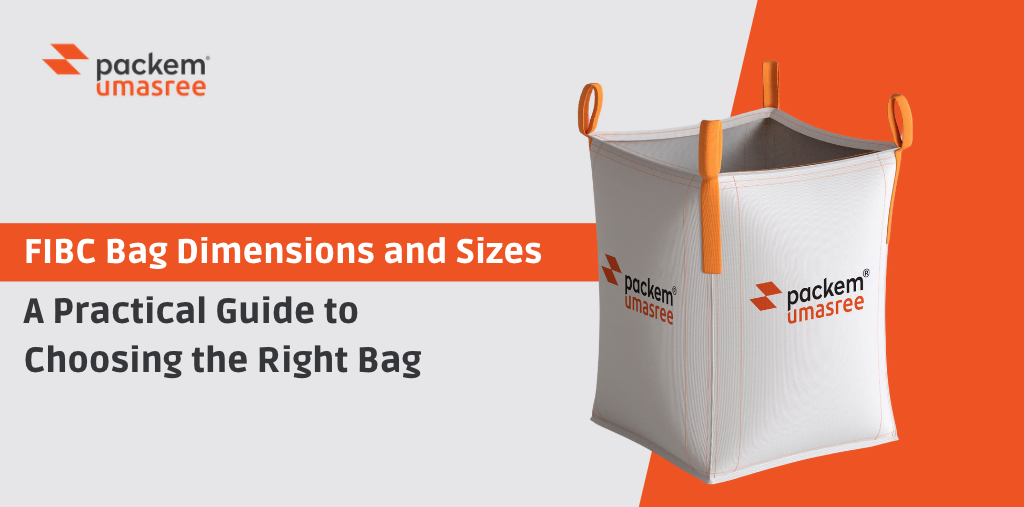
Choosing the right Flexible Intermediate Bulk Container (FIBC) is about more than selecting a bag that can hold a specific weight. The dimensions, capacity, construction, filling method, discharge style, and handling requirements all affect how well a bulk bag performs during storage, transportation, and loading.A bag that is too small may not hold the required quantity, while an oversized bag can waste warehouse and transport space. The right dimensions can also improve stacking, handling, product protection, and logistics efficiency.For businesses using bulk packaging for agriculture, chemicals, food ingredients, construction materials, minerals, and other products, understanding how FIBC sizes work makes the selection process much easier.
What are FIBC Bag Dimensions?
FIBC dimensions refer mainly to the bag’s length, width, and height, usually expressed in millimetres, centimetres, or inches. These measurements describe the physical size of the empty bag, while its capacity indicates how much material it can accommodate.For example, a specification may describe a bulk bag using measurements such as:900 mm × 900 mm × 1100 mmThis means the bag is approximately 900 mm long, 900 mm wide, and 1100 mm high when measured according to the manufacturer’s specification.However, dimensions alone do not determine the actual usable capacity. The type of fabric, construction, filling characteristics, safety factor, material density, and design can all influence the final performance.That is why buyers should consider the complete specification rather than selecting a bag based only on its measurements.
How FIBC Size and Capacity Are Related
FIBC capacity is commonly discussed in terms of volume, weight, or both.A larger bag does not necessarily mean it can safely carry a heavier product. The maximum safe working load depends on the bag’s construction and tested specifications.For example, two bags could have similar external dimensions but different safe working loads because they use different fabric weights, stitching configurations, lifting arrangements, or safety factors.The material being packed also matters.A bag filled with a dense material such as certain minerals or powders can reach its weight limit before the bag is physically full. A lighter agricultural product may occupy much more of the available volume without reaching the same weight.Therefore, selecting the right bulk bag requires answering two questions:
How much material needs to be packed?
How much space does that material occupy?
These two factors should always be considered together.
Common FIBC Sizes and Configurations
There is no single standard size that works for every application. Manufacturers can produce bulk bags in different dimensions according to the customer’s product, filling equipment, transportation method, and storage requirements.Common configurations may include bags around:
800 × 800 × 900 mm
900 × 900 × 1000 mm
900 × 900 × 1100 mm
1000 × 1000 × 1000 mm
1000 × 1000 × 1200 mm
1000 × 1000 × 1500 mm
These examples are only indicative. The appropriate dimensions should be confirmed according to the product and handling requirements rather than treating them as universal standards.Custom dimensions can be particularly useful when businesses need to maximise container utilisation, fit bags into existing warehouse locations, or match automated filling and discharge systems.
Understanding FIBC Types: A, B, C, and D
Dimensions and construction are only part of FIBC selection. The electrostatic classification of the bag is also important, particularly when handling powders, flammable materials, combustible dust, solvents, or products in potentially hazardous environments.FIBCs are commonly classified as Type A, Type B, Type C, or Type D according to their electrostatic properties. Each type has different considerations for static electricity and grounding.
Type A FIBC Bags
Type A FIBCs are made from insulating fabric and do not provide specific electrostatic protection.They may be suitable for applications where there is no risk associated with electrostatic discharge, such as when the packaged material and surrounding environment are not flammable or combustible.Type A bags should not be selected for applications where electrostatic discharge could create a fire or explosion hazard.
Type B FIBC Bags
Type B FIBCs are made using materials with controlled electrical breakdown characteristics. They can reduce the risk of certain types of electrostatic discharge compared with Type A bags.However, Type B bags are not conductive and should not be treated as a substitute for a grounded conductive FIBC in applications where grounding is required.The suitability of Type B depends on the material being handled, the environment, and the applicable safety requirements.
Type C FIBC Bags
Type C FIBCs, also known as conductive FIBCs, contain conductive threads or components arranged in a suitable pattern. They are designed to safely dissipate electrostatic charge when properly grounded.Grounding is a critical part of using a Type C FIBC. The bag should be securely connected to an appropriate grounding system before filling or emptying begins and throughout the relevant operation.This makes Type C FIBCs an important consideration when handling combustible or flammable materials in environments where electrostatic discharge presents a potential hazard.
Type D FIBC Bags
Type D FIBCs use static-dissipative materials or specialised fibres designed to dissipate electrostatic charge without requiring a conventional grounding connection.They can be considered for applications where electrostatic control is required and where the product and operating environment are suitable for Type D construction.Type D bags should still be selected and used according to the manufacturer’s specifications and the applicable safety requirements for the application.
How Should You Choose Between Type A, B, C, and D?
The choice should not be based simply on the bag’s dimensions or lifting design. Consider:
Whether the product is flammable or combustible
Whether combustible dust may be present
Whether the operating environment presents an ignition risk
Whether electrostatic discharge could create a hazard
Whether grounding facilities are available
Whether the bag will be filled or discharged in a potentially hazardous environment
The type of liner being used
Applicable standards and manufacturer recommendations
For safety-critical applications, the FIBC supplier should be given complete information about the product and operating environment so the appropriate FIBC type can be specified. FIBCA also recommends consulting the supplier for the specific application and handling environment.
Choosing Dimensions Based on the Material
The product being packed is one of the most important factors when determining the appropriate bag size.
Powders
Fine powders may require a carefully selected construction to control leakage and product flow. A suitable liner, top closure, and discharge configuration may also be necessary.For fine or sensitive materials, a Circular FIBC bag can be considered because its seamless circular fabric construction can support applications where minimising internal seams is important.
Granules and Plastic Materials
Granules often flow differently from powders and may require a different filling and discharge arrangement. The bulk density of the material should be considered before deciding on the bag’s dimensions.
Agricultural Products
Grains, seeds, feed, and similar products can have different bulk densities depending on the material and processing method. The bag should provide sufficient volume while maintaining the required safe working load.
Construction and Mineral Materials
Dense products such as sand, minerals, and certain construction materials can place substantial loads on the container. In these applications, the bag’s construction, fabric strength, seams, lifting loops, and safe working load become particularly important.
The Importance of Bag Shape
The physical shape of an FIBC after filling can affect storage and transportation efficiency.A conventional bag may bulge when filled, requiring additional space between bags. This can reduce how efficiently bags fit within a warehouse, truck, or shipping container.A baffle bag, by contrast, incorporates internal baffles that help the container retain a more square or rectangular shape after filling. This can make the bags easier to stack and can improve space utilisation.Packem Umasree offers Baffle FIBC bags as part of its range of rPET bulk packaging solutions, alongside U Panel, Circular, and Single Loop designs. Each construction serves different handling and application requirements.
U Panel, Circular, Baffle, or Single Loop?
Dimensions should not be considered separately from construction.
U Panel FIBC Bags
U Panel bags use a U-shaped panel combined with additional side panels. This construction provides a stable base and can be suitable for applications involving heavier loads.They can also be manufactured according to the required dimensions, bag type, and handling specifications.
Circular FIBC Bags
Circular bags are made from seamless circular fabric. Their construction can be useful for applications involving fine materials where reducing potential leakage points is important.
Baffle FIBC Bags
Baffle bags use internal panels to help maintain their shape when filled. This makes them useful where stacking and efficient use of storage or transport space are priorities.
Single Loop FIBC Bags
Single Loop bags use a single lifting loop and can be designed for particular handling systems. The lifting arrangement should always be compatible with the equipment used at the facility.The right design therefore depends not only on the required dimensions but also on how the bag will be filled, moved, stored, and emptied.
What Other Specifications Should You Check?
Before ordering bulk bags, dimensions should be reviewed alongside several other specifications.
Safe Working Load
The Safe Working Load (SWL) indicates the maximum load the bag is designed to carry under specified conditions. Never select a bag solely because its physical volume appears sufficient.
Safety Factor
The safety factor relates to the bag’s tested strength and intended use. Your supplier should provide the appropriate specification for the intended application.
Top Construction
Common options include open tops, spout tops, and duffle tops. The choice depends on the filling method and the level of product protection required.
Bottom Construction
Flat bottoms can work for straightforward discharge, while discharge spouts can provide greater control when unloading powders, granules, or other bulk materials.
Liner Requirements
Moisture-sensitive, fine, or contamination-sensitive products may require an internal liner. The liner specification should match the material being packed.
Lifting Loops
The lifting configuration must work with the available forklift, crane, or handling equipment. A properly selected lifting system helps make routine handling safer and more efficient.
Material and Fabric
The fabric construction affects strength, durability, flexibility, and performance. For companies with sustainability objectives, recycled PET-based FIBC solutions can provide an alternative to conventional virgin-material packaging.
How to Calculate the Approximate Volume
A basic volume calculation can help during the initial selection process.For a rectangular bag:Volume = Length × Width × HeightFor example:1.0 m × 1.0 m × 1.2 m = 1.2 cubic metresThis gives an approximate geometric volume. It should not be treated as the guaranteed usable capacity because actual filling performance depends on the product, bag construction, filling method, and settling characteristics.Material bulk density is equally important.If a product has a bulk density of 500 kg/m³ and occupies approximately 1 cubic metre, its theoretical weight would be around 500 kg. Actual requirements should still be confirmed with the packaging manufacturer because material behaviour and filling conditions can affect the result.
A Practical Checklist for Selecting the Right Size
Before placing an order, collect the following information:
Product: What material will the bag contain?
Weight: What quantity must each bag hold?
Bulk density: How much space does the product occupy per unit of weight?
Required dimensions: What space is available for storage and transport?
Filling method: How will the bag be filled?
Discharge method: How will the material be removed?
Handling equipment: Forklift, crane, or another system?
Storage conditions: Indoor, outdoor, stacked, or unstacked?
Liner: Is additional product protection required?
Safety requirements: What SWL, safety factor, and FIBC type are appropriate?
Providing this information to the manufacturer allows the bag to be designed around the actual application instead of relying on a generic size.
Why Custom Dimensions Can Make Sense
Standard sizes are convenient, but they are not always the most efficient choice.Custom-sized bulk bags can help businesses match packaging with their production equipment, warehouse dimensions, pallet configuration, shipping requirements, and product volume.For example, a bag designed to fit a particular container height may allow better use of available vertical space. Similarly, a bag with a suitable footprint may improve warehouse stacking without unnecessarily increasing the empty space between units.Packem Umasree produces customisable rPET FIBC solutions and offers multiple constructions, including U Panel, Circular, Baffle, and Single Loop bags. Its product range is designed around different industrial handling and packaging requirements.
Final Thoughts
Selecting the right FIBC is not simply a matter of choosing the largest available bag. The best specification balances dimensions, capacity, material density, construction, SWL, handling method, filling and discharge requirements, storage conditions, and transportation needs.Start with the product and the required load. Then determine the volume, available space, handling method, and appropriate bag construction. From there, a manufacturer can recommend the dimensions and specifications that match the application.For businesses looking to combine customised bulk packaging with recycled materials, Packem Umasree offers rPET FIBC solutions based on a Bottle-to-Bag approach, with multiple bag constructions available for different applications.A well-specified bulk bag can do more than carry a product. It can improve handling, make better use of storage and transport space, and support the operational and sustainability goals of the business.