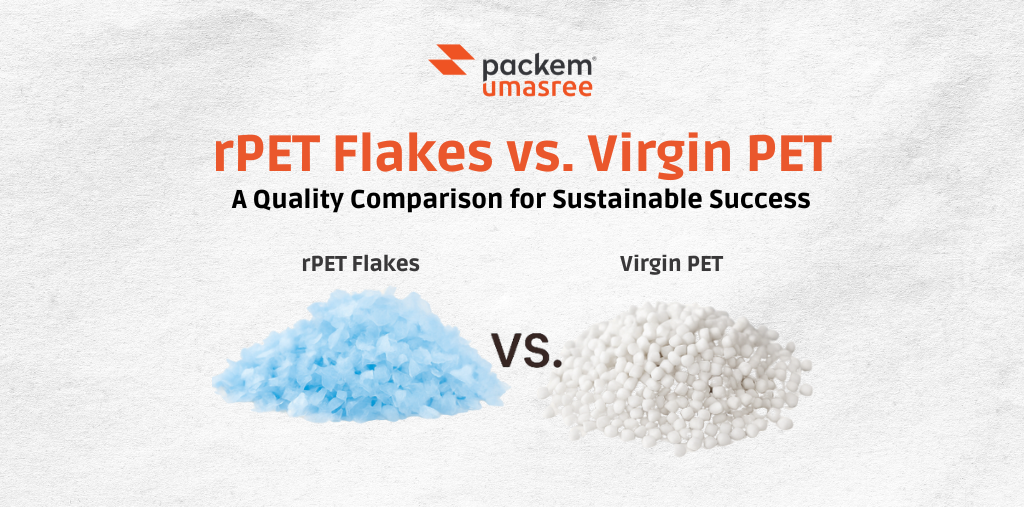
Understanding the Basics: rPET Flakes vs. Virgin PET
What is Virgin PET?
Virgin PET is a petroleum-based plastic resin used widely for packaging due to its strength, clarity, and food-safe properties. It is manufactured using fossil fuels and undergoes multiple energy-intensive processes to produce the final product.What is rPET?
rPET stands for recycled PET. It is made by collecting and processing post-consumer PET products like used plastic bottles. These bottles are converted into rPET flakes, which are then transformed into high-quality materials used for manufacturing products such as rPET FIBC bulk bags, PET pre-form, Yarn & textiles.
At Packem Umasree, our rPET bags are manufactured exclusively from PET flakes, not from chips or granules, ensuring full traceability and environmental integrity.The RPET Bulk Bag Manufacturing Process
Our RPET bulk bag production process ensures maximum sustainability and quality:- Sourcing of Bottles – Only clean, high-grade PET bottles are selected.
- Washing Line – Bottles are cleaned thoroughly to produce clear rPET flakes.
- Extrusion – Flakes are extruded into high-tenacity rPET tapes, which are the base material.
- Weaving – These tapes are weaved into fabrics and webbings using advanced looms and needle looms.
- Cutting & Sewing – The final fabrics are cut and stitched into customized FIBC bulk bags.
Key Quality Comparisons: rPET Flakes vs. Virgin PET
1. Sustainability
The most compelling reason to choose rPET flakes over virgin PET is its 100% sustainability. By using post-consumer bottles, the production of rPET flakes significantly reduces the environmental burden of plastic waste and promotes circular economy principles.
- Virgin PET: Depends on non-renewable resources.
- rPET Flakes: Gives plastic bottles a second life, reducing landfill and ocean waste.
2. Carbon Footprint
rPET manufacturing has upto 50% lower carbon footprint compared to virgin PET production. The energy required to recycle PET bottles and produce rPET flakes is significantly less than the energy used to extract and process fossil fuels for virgin PET.
This lower carbon impact supports global carbon neutrality goals and helps industries meet ESG (Environmental, Social, Governance) commitments.3. Mechanical Strength & Durability
One of the common myths is that recycled plastics are inferior in strength. However, rPET made from flakes retains excellent mechanical strength, comparable to virgin PET. In fact, PET is the only polymer that retains its strength even after multiple recycling cycles, enabling endless recyclability without performance compromise.4. Form Stability and Abrasion Resistance
rPET fabrics exhibit high form stability and abrasion resistance, making them suitable for heavy-duty applications. These bags are built to withstand rough handling, stacking, and transportation stress.- Form Stability: Maintains bag shape even under pressure.
- Abrasion Resistance: Offers long-lasting performance in tough industrial settings.
5. UV Resistance & Temperature Tolerance
rPET bulk bags offer excellent UV resistance, which is crucial for outdoor storage and transport. They also perform reliably under a wide temperature range, offering protection in diverse climatic conditions.6. Food-Safe and Regulatory-Compliant
rPET is the only polymer that can be used for food applications after recycling, provided it meets food-grade processing standards. This opens up safe usage in industries like dairy, agriculture, and food processing.7. Enhanced Printability
rPET fabrics derived from flakes offer better print quality, making it easier to brand and customize bags with company logos, safety instructions, or product details. This added print clarity makes rPET bags more market-ready and visually appealing, which is essential for B2B and retail applications.Why rPET from Flakes Matters?
Not all rPET is created equal. At Packem Umasree, we emphasize rPET made exclusively from flakes, as this ensures:- Consistency in Quality
- Better Control Over Inputs
- More Efficient Recycling Pathways
Myth-Busting: rPET Bags Can Be Reused Too
It’s often misunderstood that rPET bulk bags are single-use. In reality, rPET FIBC bags can be reused, just like PP woven bags, if manufactured with a Safety Factor of 6:1, which ensures higher load endurance and safety for multiple usage cycles. This makes rPET FIBC bags a viable option for businesses seeking both sustainability and reusability without compromising on safety or quality.Industries Benefiting from rPET Bulk Bags
- Agriculture & Dairy – Storage of fertilizers, green fodder, grains, silage, and animal feed.
- Food Processing – Safe, hygienic handling of food-grade ingredients.
- Construction – Packaging of cement, sand, and raw materials.
- Chemical & Industrial – Eco-packaging for chemicals and powders.
- Textile & Retail – Branding opportunities and sustainable packaging.